
Hospitality Employee Dedication
by Sheldon | Sep 29, 2026
Hospitality employee dedication isn't measured by hours worked. Learn how to recognize, develop, and appreciate the people who genuinely care about their work.

Leadership
by Sheldon | Jun 2, 2026 | 4 min read
Identifying employee potential is one of the most important parts of promoting from within.
Most restaurant promotions begin with good intentions. However, being good at your current job doesn't automatically mean you're ready for the next one.
Recognizing potential requires looking beyond technical ability, experience, and tenure.
Years ago, I spent time with an Executive Chef, an alum of Philadelphia's former Four Seasons. We met regularly to discuss the industry and even guest-lectured together in a hospitality class.
Chef had worked his way through the ranks, starting as an apprentice and eventually becoming Executive Chef after a twenty-five-year career at one of Philadelphia's most respected restaurants.
During one of our conversations, I asked what he looked for when promoting employees from within.
I expected him to talk about experience, technical ability, or tenure.
Instead, he told me he focused on identifying his "go-to" people.
These are the employees who always seem to know what's going on. They know where to find things in dry storage, recognize VIP guests and remember their preferences, and understand how the operation works beyond their own stations.
When a teammate has a question, they're often the first person people turn to.
They're also the people Chef turns to when he needs an extra set of eyes. Not because they're in charge, but because they've earned a reputation for paying attention.
In both BOH and FOH environments, attention to detail and anticipation are hallmarks of exceptional service. Michelin discusses similar qualities in its article about what makes great service.
That awareness helps maintain consistent restaurant service standards and often makes these employees strong candidates for promotion.
In another conversation, I asked Chef what he evaluated when candidates staged in his kitchen.
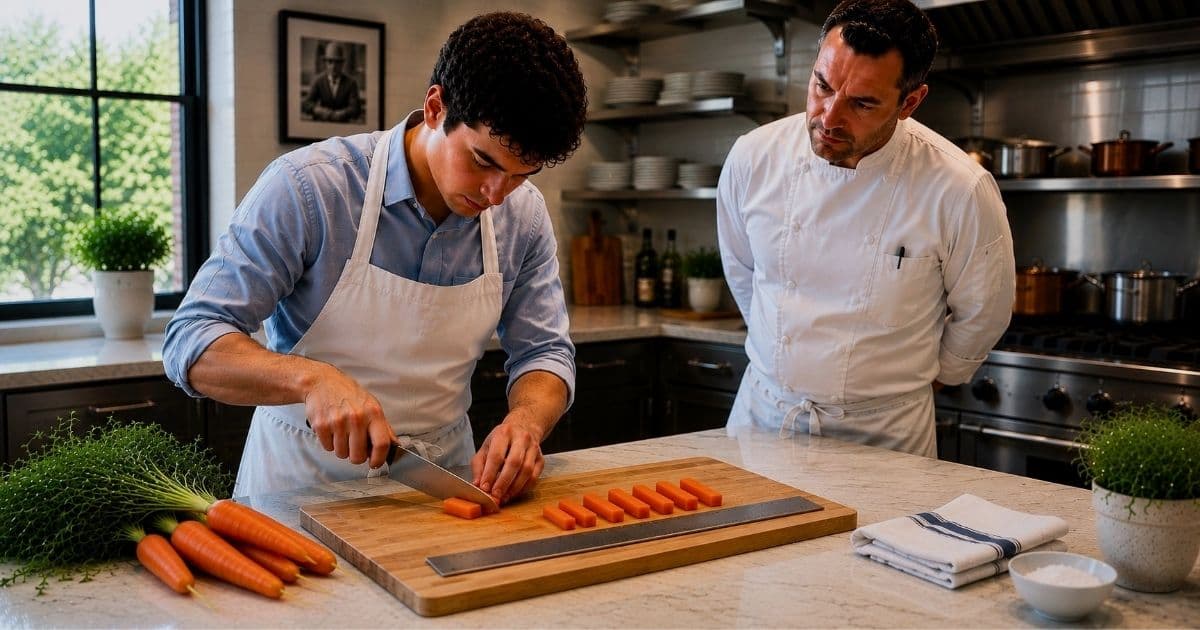
Sometimes he'd hand someone a bunch of carrots and ask them to cut them.
The exercise wasn't really about cutting carrots. He was watching everything that happened before, during, and after the first cut.
He wanted to know:
Would they ask if the carrots had been washed?
Would they ask how he wanted them cut and what size he expected?
Would they wipe their hands on their apron?
Would they stop to answer a text message or take a phone call?
Would they remain focused on the task?
Someone who immediately grabbed the carrots and started cutting was communicating one thing.
Someone who took time to understand the standards and expectations of that particular kitchen was communicating something very different.
Chef understood that every kitchen operates differently. Candidates who recognized they still had something to learn often adapted more quickly.
And those were frequently the people who eventually became his go-to employees.
Over the years, I've learned to distinguish pedigree from potential.
Pedigree tells part of the story. It tells you where someone worked, who they worked for, and which positions they've held.
Potential is a whole different animal.
Chef wasn't simply evaluating knife skills. He was looking for awareness, professionalism, curiosity, and a willingness to learn.
A candidate could do a mediocre job cutting carrots and still leave a positive impression by asking thoughtful questions, staying engaged, and demonstrating that they were trainable.
An impressive resume doesn't always reveal those qualities.
And a modest resume doesn't mean they're absent.
I've noticed the same thing in the front of the house.
A new hire who asks how they did at the end of a shift or whether anything else needs to be done before clocking out is gold.
They're seeking feedback, paying attention, and looking for ways to contribute.
These employees often make the most of structured restaurant training because they're actively participating in their own development.
A job seeker with a modest background who is curious, disciplined, coachable, and eager to learn can be every bit as valuable as someone with an impressive resume.
Sometimes more valuable over time.
For employers, it's a reminder not to confuse experience with readiness or overlook employees who haven't yet had an opportunity to demonstrate what they're capable of.
For employees, it's a reminder that career growth isn't determined solely by where you've worked. How you approach learning and responsibility matters, too.
Technical skills can be taught. Systems can be learned. Standards can be explained.
Curiosity, humility, discipline, and a genuine desire to learn are often much harder to teach.
Identifying employee potential is only the beginning.
Managers who build strong teams recognize promising employees and invest in developing them. They create opportunities to learn, take on responsibility, and build confidence.
In return, they often earn something every restaurant needs and very few can demand: loyalty.
You get back what you invest in people.
Written by Sheldon
by Sheldon | Sep 29, 2026
Hospitality employee dedication isn't measured by hours worked. Learn how to recognize, develop, and appreciate the people who genuinely care about their work.

by Sheldon | Sep 22, 2026
A great restaurant employee isn't always ready to manage. Learn what separates strong performers from employees prepared to lead a team.

by Sheldon | Sep 17, 2026
What can heavy metal music and art students reveal about restaurant culture fit? Two recruiting stories show why the smallest details can matter.
Mis en Place helps independent restaurants and hospitality businesses build stronger teams through recruiting and hiring tools created specifically for the industry.