What Changed for Line Cooks During the Labor Shortage
In May 2021, Mis en Place conducted a line cook survey during the pandemic labor shortage, gathering responses from 2,000 cooks to better understand how the crisis was affecting their employment decisions.
Restaurants were reopening, operators were scrambling to rebuild their teams, and much of the public conversation focused on the workers who seemed to have disappeared.
But had they really disappeared? Or were they making different decisions about where, when, and whether they wanted to work?
Our survey revealed a more interesting picture.
What Our Line Cook Survey Found
Of the 2,000 cooks who responded:
26% had left the hospitality industry.
41% were employed in hospitality.
33% had not yet returned to work.
The survey also reported that 15% had transitioned to another role within hospitality.
From my recruiting perspective, the most revealing findings concerned the cooks who hadn't returned to work.
Of the full survey sample:
20% were looking for the right opportunity.
7% cited COVID-related concerns.
6% cited unemployment benefits and stimulus checks.
Together, these three categories represented the 33% of respondents who hadn't returned to work.
Looking for the right opportunity is very different from having no interest in working.
That's an important distinction when you're trying to fill a kitchen.
These findings describe the 2,000 cooks who responded to our May 2021 survey, not the entire restaurant workforce.
What Cooks Were Telling Us
The numbers were interesting, but the individual responses added something statistics couldn't.
One cook wanted appropriate wages, safety precautions, and opportunities for advancement.
Another wanted a positive working environment, competitive full-time compensation, and room to learn.
A third was still employed, but no longer cooking on the line. After experiencing extremely long workweeks, that respondent didn't want to return to a restaurant kitchen.
Different cooks. Different circumstances. Different priorities.
I've spent years recruiting kitchen employees, and compensation has always been an important part of the conversation. But candidates also want to understand the schedule, the kitchen's organization, management expectations, and whether they'll have opportunities to develop their skills.
A higher hourly wage may attract someone's attention. It doesn't necessarily make the job sustainable.
What the Labor Shortage Revealed About Restaurant Hiring
During the reopening period, restaurants were trying to rebuild operations while managing staffing gaps and unpredictable business conditions.
National reporting from The Wall Street Journal, The Washington Post, and the Financial Times documented the pressures facing employers.
Our survey offered another perspective: what some cooks themselves were considering.
A cook who had left hospitality wasn't necessarily evaluating opportunities the same way as someone still employed in a restaurant.
And a cook waiting for the right position might have been available to an employer offering competitive compensation, a manageable schedule, and a well-organized kitchen.
Treating every unfilled position as evidence that nobody wanted to work overlooked those differences.
What Restaurant Operators Can Learn
Although the survey captured a specific moment in 2021, it raised questions that remain useful when recruiting kitchen employees.
Are you accurately describing the position, including compensation, schedule, and responsibilities? Does the kitchen have the staffing, equipment, and management support employees need? Are candidates receiving timely communication, and is someone prepared to train them when they arrive?
Our survey didn't measure all of these questions. They're practical recruiting considerations informed by the concerns cooks expressed.
Our Structured Hiring Process for Restaurants explores how clear expectations and consistent communication can support hiring.
Staffing decisions also have financial consequences beyond wages. The 7shifts restaurant labor cost guide offers additional context for balancing labor expenses with operational needs.
An understaffed kitchen can place more pressure on the employees who remain, creating another problem for operators already struggling to recruit.
What the 2021 Line Cook Survey Still Teaches Us
The most important lesson wasn't that cooks had stopped working or that every employee wanted the same thing.
It was that restaurant hiring challenges weren't all caused by the same circumstances.
Some cooks had left hospitality. Others had changed roles. Some were still looking for an opportunity worth accepting.
Our survey didn't establish why every cook made those decisions, and it shouldn't be used to describe today's workforce.
But it gave us a valuable reminder: when a restaurant struggles to hire, the first question shouldn't always be where all the workers went.
Sometimes the better question is what would make the right candidate want to come work for you.
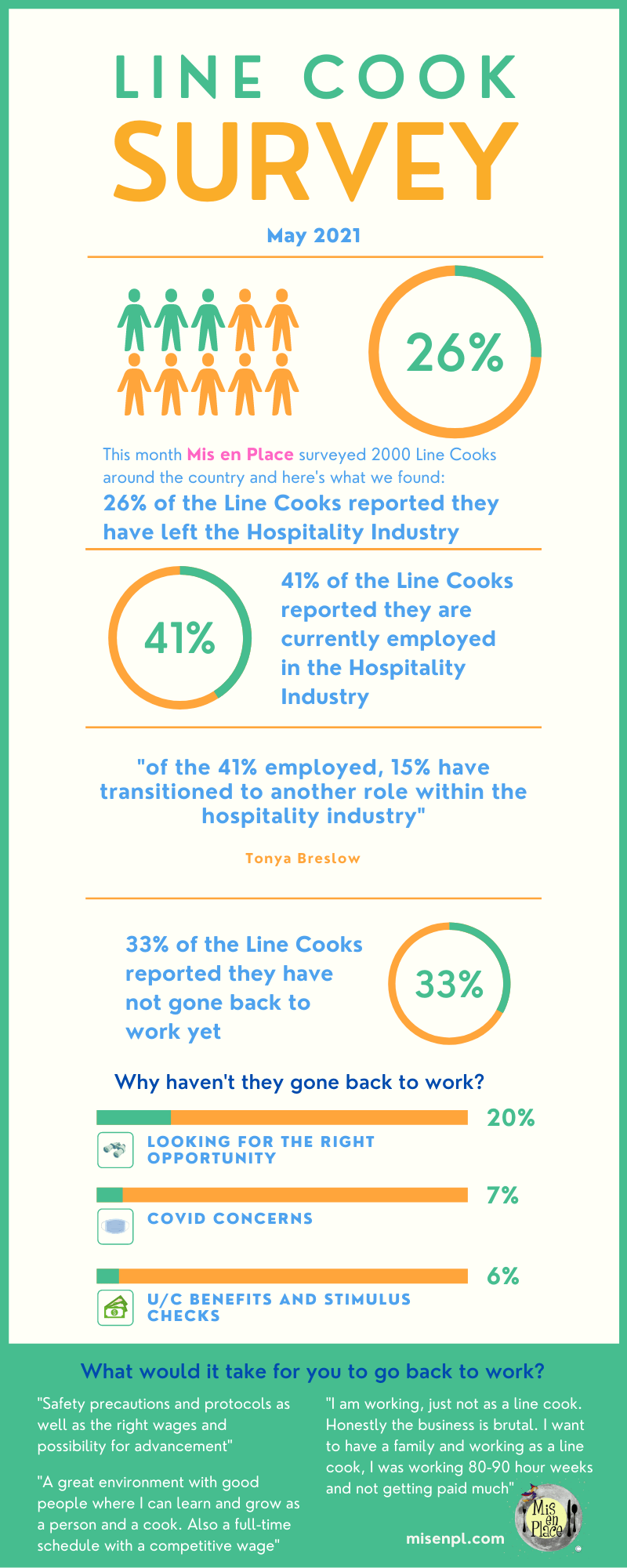
Mis en Place survey of 2,000 line cooks showing workforce shifts during the pandemic labor shortage.